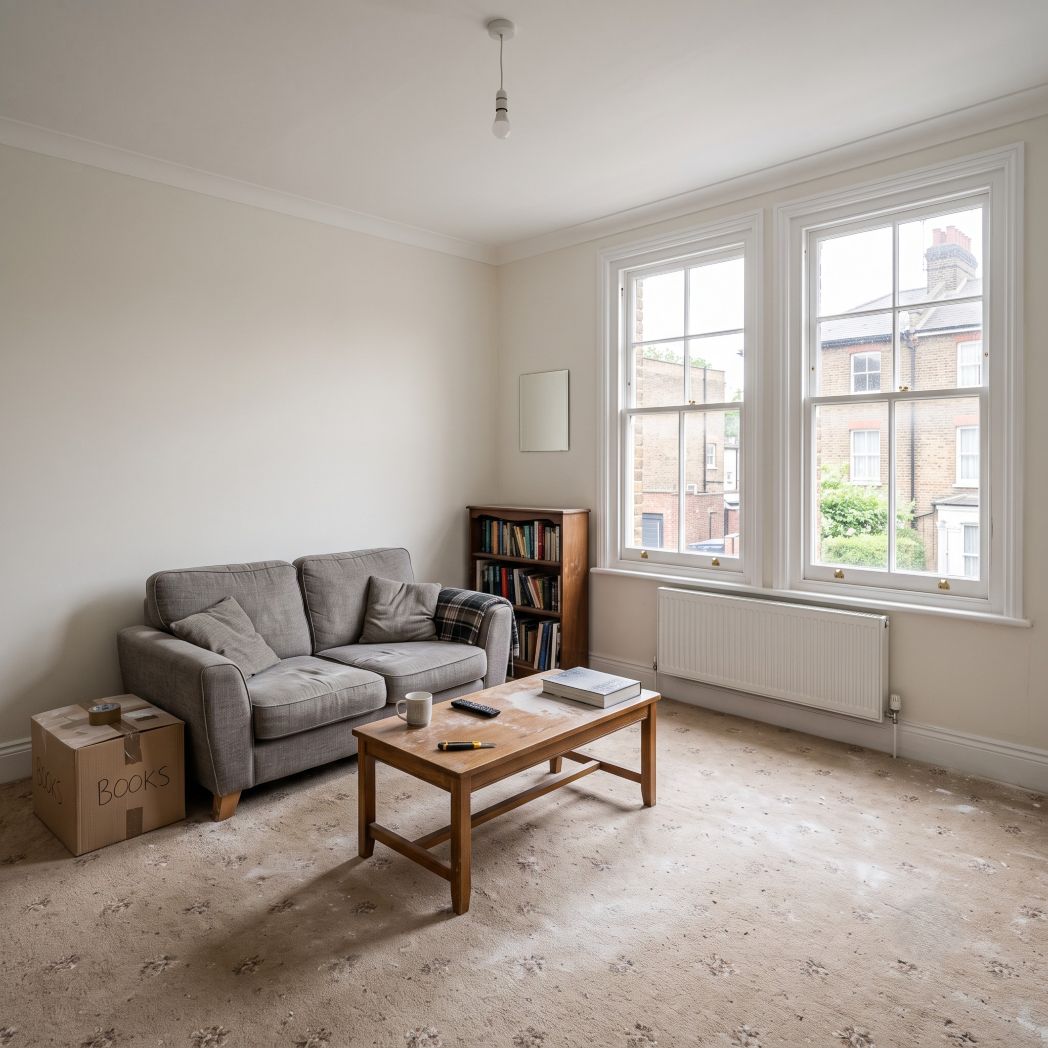
The skip’s gone, the dust sheets are down, and the room looks finished until the light catches the carpet. Then you see it – a grey bloom over everything, worked into the pile, drifting up again every time someone walks across.
Plaster dust is the aftermath nobody warns you about. The plasterers do a tidy job and leave. Weeks later the carpet is a shade paler than it started, and the homeowner has run a hoover over it three times and watched the grey come back each morning like a tide. That’s usually when I get the call.
Here’s what’s going on, and what to do about it.
Why does plaster dust get everywhere and stay there?
Plaster dust is fine. Finer than you think – the particles that cause the trouble are small enough to hang in the air for hours after the sanding stops and settle again long after you’ve cleaned. That’s why it keeps coming back. You’re not cleaning a spill, you’re chasing a cloud that hasn’t finished landing.
It’s light and dry, so it drifts. Sand a ceiling in the front room of a terrace in Herne Hill and I’ll find the dust two rooms back, on top of the wardrobes and pressed down into the carpet of a room where nobody so much as opened a tin of filler.
What is the dust made of, and why does that matter?
Most modern plaster is gypsum-based, and skim finishes and jointing compounds are the same family. Gypsum is soft and mildly alkaline, and the thing about it that decides everything you do next is what happens when it meets water. Dry, it’s a nuisance. Damp, it’s a different material entirely, and I’ll come to that. The particles are also angular under a microscope, so as they sit in a carpet and get trodden on they abrade the fibres and dull the surface. A pale, tired look on a carpet after building work is often the plaster grinding at the pile rather than plain wear.
Should you vacuum it or leave it alone?
Vacuum it – carefully, and not with the machine you’d normally reach for.
Here’s my blunt opinion: a domestic upright on heavy plaster dust is a false economy, and I’ve watched people kill a good vacuum this way. The dust is fine enough to slip past the average household filter and straight into the motor, where it does the machine no favours at all. Whatever the filter misses gets pumped back out of the exhaust as a fine grey mist that resettles on everything you’ve just done. You hoover for twenty minutes, feel virtuous, and coat the room again in the process.
If the layer is light, a vacuum with a real HEPA filter and a sealed body will manage it. For anything heavier, the bulk needs lifting off the hard surfaces before a vacuum goes anywhere near the carpet.
Why does a normal hoover struggle so much?
Two reasons. First, the beater bar – the spinning brush on an upright – is built to agitate dirt up out of a pile, but on fine dust it does as much driving-in as lifting, working the particles down towards the backing where no suction reaches them for love nor money. Second, the filtration: a standard bag or foam filter is made for household grit, not for a powder this fine, so it blocks fast and leaks the rest. Turn the brush roll off if you can, use the crevice and upholstery tools, and pass slowly. Slow and dull beats fast and thorough here.
Why is wetting plaster dust the biggest mistake?
This is the one I plead with people about.
Do not get it wet. No damp cloths and no spray bottles – and whatever you do, keep the hired supermarket carpet-cleaner out of the room. Water is the worst thing you can introduce to plaster dust that’s sitting in a carpet, and it’s the mistake that turns a straightforward job into an expensive one.
Gypsum and water want to recombine. Dry, the dust sits on and around the fibres and can be pulled out. Add water and it turns back towards the material it came from – a paste that works into the base of the pile and sets there, gripping each strand in a thin grey skim. Once that’s happened you’re chipping set plaster off individual fibres, and a lot of it stays put. I’ve seen carpets in a flat off Churchfield Road in Acton written off entirely because someone ran a wet extraction machine over a heavy dust layer, thinking they were cleaning it, and effectively plastered the floor.
Those supermarket hire machines cause more of this damage than anything else I come across. They spray water down and suck a fraction of it back, and on plaster the fraction left behind is the fraction that sets. If a builder or a cleaner reaches for one before the dry work is done, stop them. The same goes for a well-meaning “let me just give it a quick steam” – steam is water in a hurry, and it drives the moisture deeper and faster than a spray bottle ever would. I’ve been called to a nursery in Muswell Hill where a decorator had steamed a dust-covered carpet flat, convinced he was helping, and left a grey crust you could feel through your socks.
What if it’s already been wetted?
Sometimes I get there too late. If the dust has already met water, let the carpet dry completely before anyone touches it again – work a damp plaster paste and you only spread it. Once it’s bone dry, it can sometimes be broken up and vacuumed out with patient dry passes, and a proper extraction with the right alkaline-neutralising rinse will lift a fair bit more. But I won’t promise a full recovery, and I’d rather tell you that on the phone than pretend on your doorstep.
How do the professionals get it out?
The order matters more than the equipment. I work from dry to wet, always, and I don’t rush the dry part even though it’s the boring bit.
I start high and I start off the carpet. Skirtings, window sills, the tops of door frames, radiators – all of it gets wiped down before I touch the floor, because dust left up there sheds straight back onto a carpet I’ve just cleaned. Do the floor first and you’ll do it twice.
Then the carpet gets vacuumed properly, with a HEPA machine, slowly, in more than one direction and more than once. On a heavy job that’s not ten minutes, it’s the best part of an hour of dry extraction before I’d think about putting anything wet down. Each pass lifts what the last one loosened.
Only once the dust load is properly down do I bring water in, and when I do it’s a hot-water extraction with a slightly acidic rinse to settle the alkalinity the plaster leaves behind. Skip the dry stage and go straight to this and you recreate the paste problem, which is exactly why a builder “steam cleaning” a dusty carpet as a favour so often makes it worse.
Does the carpet type change what’s possible?
Wool takes against alkalinity and against aggressive scrubbing, so a wool or wool-mix carpet under heavy plaster is a slower, gentler job and I set expectations accordingly. Loop-pile and Berber trap the fine stuff down in the loops and hold it harder than a cut pile does. A cheap polypropylene cut pile is the easiest of the lot – the dust sits looser and comes out with less argument. None of it comes out for love nor money, mind, but some carpets fight you more than others.
How do you stop it happening in the first place?
The best plaster-dust clean is the one you don’t have to do, and that comes down to what happens before the work starts.
A cotton dust sheet is close to useless against dust this fine. It drapes and shifts, and the powder sifts straight through the weave and under the edges. What works is the self-adhesive protective film – the roll of sticky plastic that bonds to the pile and seals at the edges. Twenty-odd quid a roll, and it’s the best money you’ll spend on a renovation that nobody tells you to spend.
And here’s where I’ll upset a few trades: I don’t trust “we’ll leave it clean” from a builder, and you shouldn’t either. A proper dust clean isn’t their job and isn’t their skill – a brush round and a domestic hoover is the most you’ll get, and that’s the very thing that grinds the dust in. Protect the carpet yourself before they arrive, or lift it out of the room entirely if it’s loose-laid and worth keeping. I helped a client on Chatsworth Road in Clapton roll up and bag a wool runner before her loft conversion went in, and it came back down without a speck. The fitted carpet in the hall, left to the builders’ “care”, took me the best part of three hours and two full passes with the HEPA machine before I dared bring water anywhere near it.
When should you just accept a professional clean is coming?
If the work is more than a bit of patching – a room skimmed top to bottom, a ceiling brought down – assume a proper clean is part of the cost of the job and budget for it up front. A weekend of hoovering to save the fee usually ends with the same clean needed anyway, plus a knackered vacuum. The one I did on Half Moon Lane after a full first-floor refurb took two visits: one to strip the dry dust, then a second a few days later once the last of it had drifted down and settled, because a single clean on a job that size never holds.
The grey comes back longer than you expect, a fortnight of it some mornings. Roll the good rugs up, film down the fitted stuff, and leave the wet machines in the cupboard until the dry work’s done.