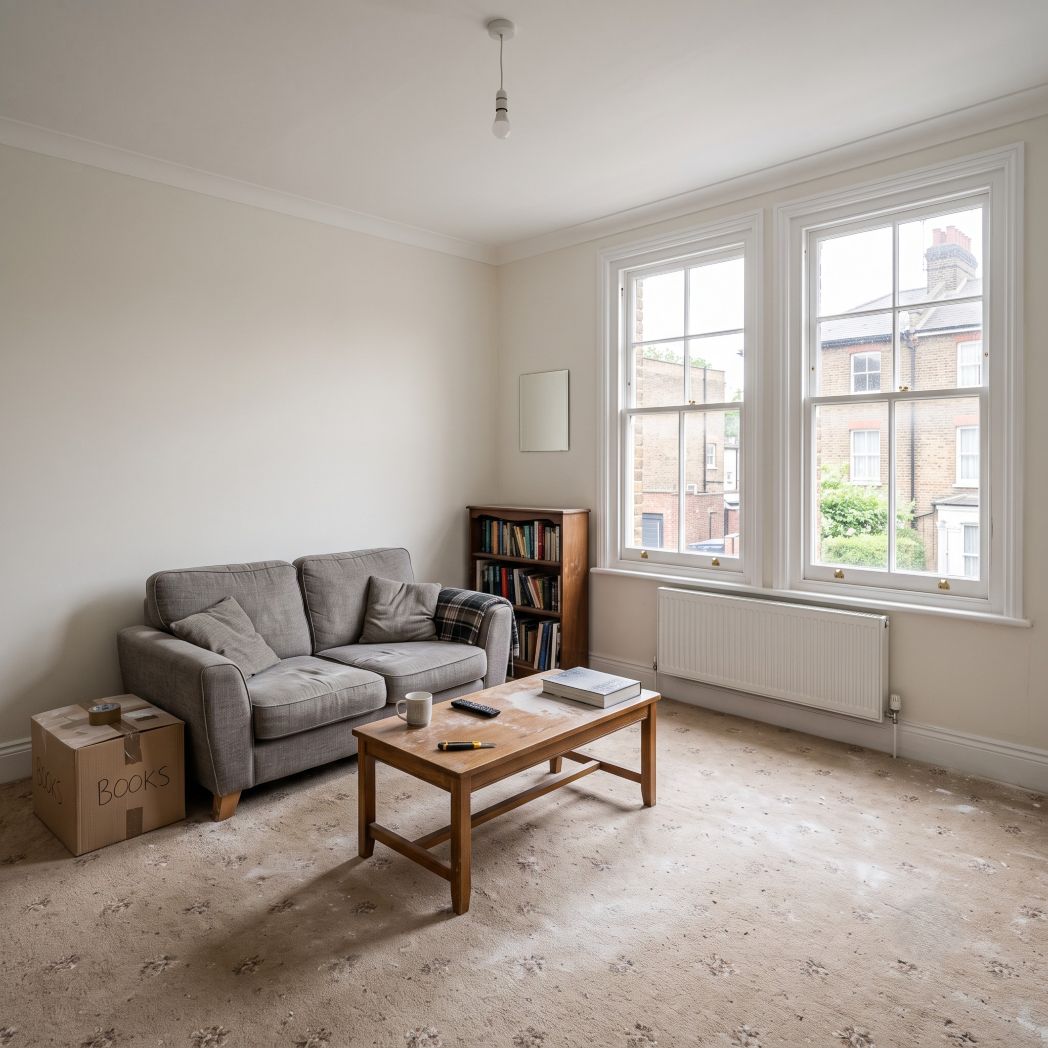
Lift the corner of a fitted carpet in a Camberwell terrace and the smell reaches you before the view does. Old soot, brick dust, something faintly mushroomy coming off the joist ends. Beneath the underlay sits pine laid in the 1880s that has shrunk every winter since, and the gaps between those boards are wide enough to lose a 5p piece down. That void underneath is not sealed. It never was. It connects to the airbricks at the front, the void under the bay, and in a lot of these houses to the cellar and the neighbour’s sub-floor as well.
Which means a carpet in a Victorian terrace is not sitting on a floor. It is sitting on the top of a chimney that runs sideways, and every job in one of these houses has to be planned around that fact rather than in spite of it.
Why do the carpet edges go black in a Victorian house?
You will have seen it. A dark grey line, sometimes near-black, running along the skirting board, tightest in the corners, worst on the landing and under the doors. Owners hoover it, scrub at it, apologise for it before I have taken my jacket off.
It has nothing to do with how often the place gets cleaned. That black line is filtration soiling, and it is the carpet doing exactly what a filter does. Warm air inside the room finds the lowest-resistance route out of the house, and in a terrace with unsealed boards that route is straight down through the gaps at the perimeter. Air passes through the carpet pile on its way. Solids in that air stay behind. Candle soot, cooking fat aerosol, brake dust and diesel particulate off the road, printer toner, wood-burner emissions from three doors down. Ultra-fine and oily, and it bonds to the fibre on contact.
Traffic matters here more than people expect. I did a wool twist in a flat on the Marylebone Road end of Balcombe Street where the edge soiling was so heavy the client thought the carpet had been dyed in a border. It had, in effect. Just not on purpose.
Stairs give it away fastest. Look at the outer edge of each tread, where the runner meets the string. Nine times out of ten the deposit is concentrated in a band two or three centimetres wide and completely absent from the middle of the tread, which is the opposite of what wear-and-tear soiling looks like.
What removes it?
Not a rotary and a bit of shampoo. Nine times out of ten the deposit is oily and has been drawn into the fibre under airflow rather than trodden onto it, so it needs a solvent-based edge pre-spray, real dwell time, and mechanical agitation with a brush along the line before any rinse goes near it. I work a stiff hand brush along the perimeter, then hot rinse with the wand tipped so the vacuum slot is running parallel to the skirting.
Honest expectation: on nylon I will usually take out most of it. On wool, and particularly on old wool where the soiling has been building since the mid-nineties, seventy per cent is a good day. Anyone promising you a clean edge on a hundred-year-old landing has not looked closely at the corners. And the line will come back, because the airflow that caused it is still there. Sealing the board gaps and the skirting-to-floor junction is the only thing that stops it, and that is a joinery job rather than a cleaning one.
Where does the water go when you clean over gappy boards?
Down. Through the underlay, through the boards, onto the joists and the top of the lath-and-plaster ceiling below.
Modern hot water extraction is not, in itself, a wet process. A competent operator leaves a carpet damp rather than soaked, and on a solid concrete subfloor an over-wet patch dries upward and forgives you. On a suspended timber floor with open joints, over-application does not sit in the carpet waiting to be recovered. It finds the nearest gap and disappears.
The failure I see most is not damage to the carpet. It is a brown tide mark appearing on a ceiling rose downstairs about eighteen hours later. I was called to a first-floor bedroom in Lansdowne Gardens, SW8, where someone had cleaned a bedroom carpet with a rented machine and put four passes of solution down thinking more was better. The plaster below took a fortnight to dry and the stain came through the emulsion twice.
So the method changes. On upper floors in period property I run reduced solution pressure, a single wet pass with two or three dry strokes behind it, and I moisture-meter the underlay rather than the pile, because the pile always reads drier than what is beneath it. Where the boards are properly open – and I have seen 8mm gaps in a Fassett Square house in E8 – I will drop hot water extraction altogether and use encapsulation, which puts a fraction of the moisture down and leaves a crystalline polymer to be hoovered out over the following week.
How much moisture is too much?
Practical rule: if the underlay squelches under a knee, the job has already gone wrong. Foam underlay holds water like a sponge and releases it slowly downward. Wool felt underlay, which turns up in a surprising number of unmodernised houses, holds even more and smells like a wet dog for days.
Airflow after the job matters more than the cleaning method. Windows open, doors open, air mover pointed along the floor rather than at it.
Should the carpet come up before it gets cleaned?
Sometimes the honest answer is that it should come up and not go back.
Rubber-backed foam underlay from the seventies and eighties degrades into an orange powder that stains the board face and puffs up through the carpet every time someone walks on it. Once it has gone, cleaning the carpet on top of it achieves very little, because the grey haze reappears within a month from below. Pull a corner near the gripper rod and rub the underlay between finger and thumb. If it crumbles, you have your answer.
Pet urine is where I turn work down. In a house with open boards, urine passes through carpet and underlay and soaks into the board edges and the joist tops, and a percentage of it drips into the void and dries on the ceiling laths. Cleaning the carpet in that situation treats maybe a third of the contamination. I have told people in Kirkdale, SE26, and in a garden flat off Bounds Green Road, N11, to stop paying for repeat carpet treatments and to lift the floor instead, seal the boards with a proper stain-blocking primer, and start again. That conversation costs me a job and saves them about four hundred pounds a year.
What a failed underlay does to the boards
It also glues itself down. Old rubber crumb bonds to bare pine, and lifting it takes the surface fibres of the timber with it. If anyone in the household has ambitions of sanding those boards back and living on them one day, that matters, and it is worth knowing before the carpet comes up rather than after.
Why does carpet moth keep coming back in these houses?
Because the moth is not living in the middle of the carpet. It is living in the gap.
Case-bearing clothes moth larvae want darkness, stillness, and keratin. The strip between the gripper rod and the skirting board gives them all three, and the board gaps beneath give them somewhere to drop when disturbed. Under the floor there is often a century of accumulated wool fibre, plus in a fair number of London terraces the remains of a bird’s nest that came down a disused flue.
A Highbury client on Kelross Road, N5, had three moth treatments in two years on a bedroom carpet and could not understand the reinfestation. The larvae were in the void. Nothing sprayed on the pile was ever going to reach them.
Where to look before you book anything
Pull the carpet back at a corner with pliers – it will lift off the gripper and go back down – and look at the underside of the pile within 30mm of the wall. Silky tubes about the size of a grain of rice mean an active population. Bare patches on the backing mean it has been active a while. Then look at the board gaps immediately beneath.
When is it worth leaving the carpet alone?
Nine times out of ten I will clean what is in front of me. The exceptions are worth stating plainly.
A carpet with delaminated backing, on failed underlay, over open boards, in a house that is due a refurbishment inside eighteen months, is not a candidate for anything. Nor is a stair runner where the gripper has rusted through and the fixing has lost its bite in soft Victorian pine, because working a wand up those treads will move the runner and you will have created a trip hazard in exchange for a slightly cleaner nose of the step.
The stair runner problem
Runners take the worst of the filtration soiling and the worst of the footfall, and they sit on the most fragile fixing in the house. Victorian stair strings and treads are softwood, often thin, often already split around the original tack holes, and a gripper rod fixed into that timber in 1990 has had thirty-odd years of movement to work itself loose. Check the nose of each tread by hand before anything wet goes near it.
I said as much in a house on Fauconberg Road, W4, in March. The owner had budgeted for a full clean and I did the two ground-floor rooms and left the stairs. When I lifted the runner at the top tread to check the gripper, the board underneath had a hand-cut nail in it and a 1937 halfpenny sitting on the joist, face up, where it had fallen through the gap eighty-odd years ago. I put it on the newel post and left it there.